Best Lumbar Support Cushions in 2026: What Independent Reviewers Actually Found
Your back should not pay the price for a chair that offers no lumbar support — and yet most office chairs, car seats, and dining chairs do exactly that. Lumbar cushions offer an immediate, low-cost fix, but the market is crowded with options that feel great in the unboxing and slip out of position by lunchtime.
The short version: Dr. Alison Lejkowski’s 2026 chiropractor-tested roundup at PropelActive and Jon Muller’s long-running guide at Ergonomic Trends both land on the Everlasting Comfort as the most versatile everyday pick. BTOD’s Ryan Bald disagrees and awards best value to the humbler Samsonite. For clinically backed support on a budget, Daniel Strongin at TheReviewRewind rates the OPTP McKenzie Lumbar Roll as hard to beat at under $30. No single cushion tops every list — the disagreements below are as instructive as the consensus.
The 2026 Field at a Glance
| Product | Best For | Shape / Fill | Approx. Price | Sourced From |
|---|---|---|---|---|
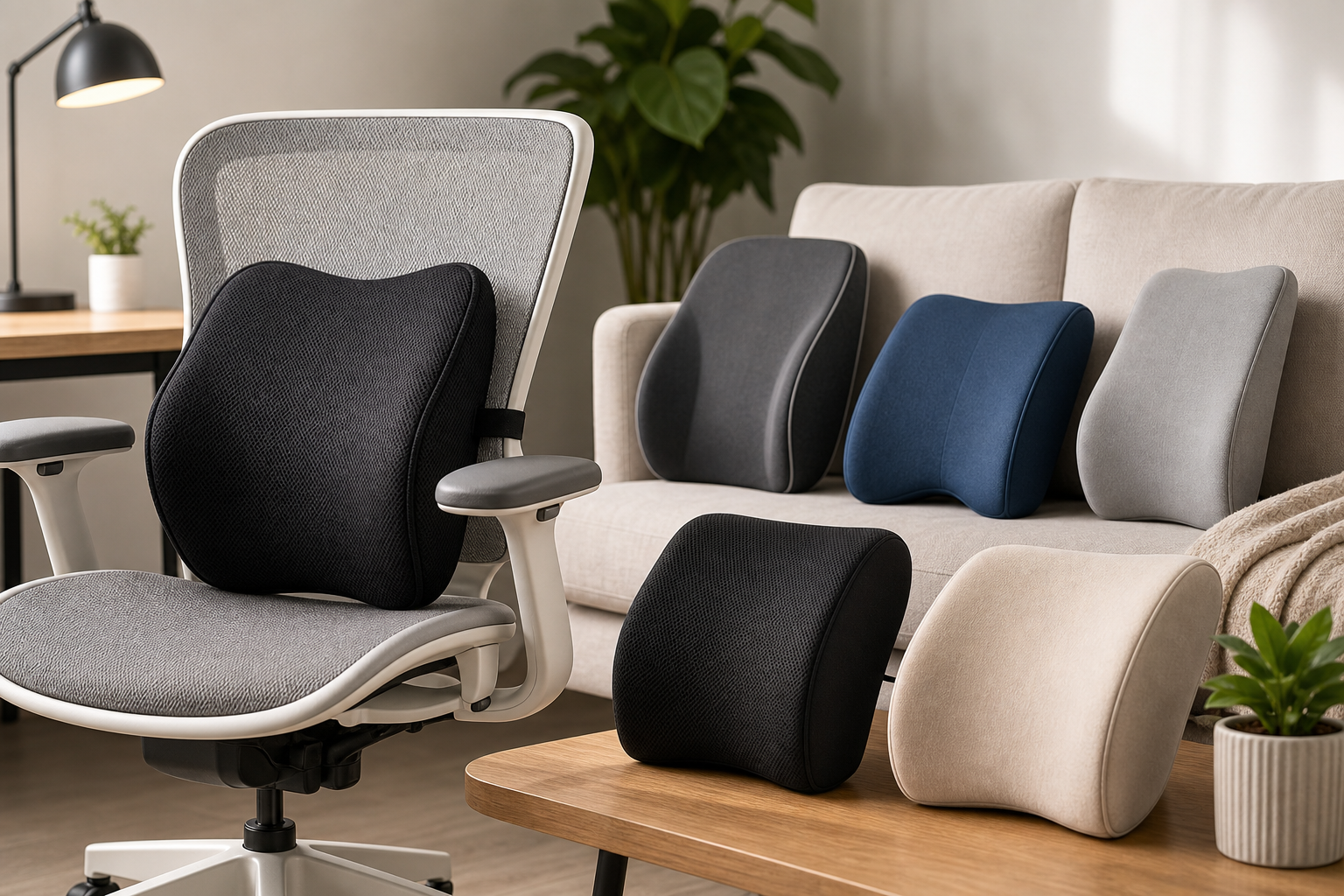
| Everlasting Comfort Lumbar Pillow | Everyday office & home versatility | Rectangular / memory foam, dual strap | ~$30–$45 | PropelActive (Dr. Lejkowski), Ergonomic Trends (Muller), BTOD (Bald) |
| Samsonite Lumbar Support Pillow | Best value for upright sitters | Contour / memory foam, single strap | ~$20 | BTOD (Bald), Girlboss |
| OPTP McKenzie Lumbar Roll | Physio-backed; travel & commuting | Cylindrical roll / polyurethane foam | ~$30 | TheReviewRewind (Strongin), Ergonomic Trends (Muller) |
| Cushion Lab Back Relief Lumbar Pillow | Dense support for back-pain sufferers | Tooth-shaped / Hyperfoam, single strap | ~$54–$66 | Ergonomic Trends (Muller), BTOD (Bald), Reviewed.com (Cohen) |
| QUTOOL Lumbar Support Pillow | Maximum stability; cooler environments | Full-back / memory foam, dual strap | ~$25–$40 | BTOD (Bald), Girlboss |
| Tempur-Pedic LumbarCushion | Premium office & travel comfort | Contour / proprietary TEMPUR foam | ~$89–$120 | TheReviewRewind (Strongin), Healthline (Fisher / Minnis DPT) |
| Purple Back Cushion | Hot sitters; car use | Grid / GelFlex elastic polymer | ~$45–$65 | Healthline (Fisher / Minnis DPT) |
What the reviews agree on
A strap is non-negotiable. Every hands-on tester who compared strapped versus strapless models concluded that a cushion without a strap will wander. In her March 2026 PropelActive roundup, Dr. Lejkowski found the strapless Niceeday required repositioning every single time she stood up and sat back down. Ryan Bald at BTOD made strap security his primary ranking criterion across the five Amazon models he tested in May 2026 — the results bore it out, with stability proving a bigger differentiator than foam density or cushion shape.
Memory foam dominates — and earns its place. The vast majority of top picks across all sources use memory foam in some form. Jon Muller at Ergonomic Trends notes that memory foam adapts to the individual curve of a user’s lower back, making it more forgiving than rigid supports for people who shift position through the day. The clear exception is the McKenzie Lumbar Roll, whose firmer polyurethane foam is preferred by physical therapists precisely because it does not conform — it maintains a fixed lumbar curve regardless of how the user leans.
Heat buildup is the category’s Achilles heel. Bald at BTOD flagged this as a near-universal issue in closed-back designs: the Everlasting Comfort heats up quickly during extended sessions, and the otherwise impressive QUTOOL’s heat buildup rendered it effectively unusable in his test. Healthline’s Ash Fisher — whose review was medically assessed by Gregory Minnis, DPT — lists breathability as a key selection criterion. The Kingphenix mesh-back design earned Bald’s specific praise as “the most breathable option” in his field, a meaningful edge for anyone who runs warm or works in a poorly ventilated room.
Cushions supplement; they do not replace a proper chair. Bald concludes his BTOD piece recommending chairs with integrated lumbar support as the superior long-term investment, framing cushions as a band-aid for a chair that fundamentally lacks support. Kevin Lees, DC, director of chiropractic operations at The Joint Chiropractic, is more enthusiastic, telling reviewers that lumbar pillows genuinely “relieve pressure on the lower back and encourage proper posture” — but even he implies they work best within a broader ergonomic routine that includes movement breaks.
Price does not guarantee performance. Bald rates the $20 Samsonite above the far more popular Everlasting Comfort for foam quality. Strongin at TheReviewRewind found the $30 McKenzie roll delivered “comparable ergonomic support at a fraction of the cost” of the Tempur-Pedic, which retails at roughly three to four times the price. Multiple sources converge on the view that spending more correlates weakly with real-world back support.
Where they disagree
Is the Everlasting Comfort actually the best all-rounder?
Dr. Lejkowski (PropelActive, March 2026) and Muller (Ergonomic Trends) both give the Everlasting Comfort their top overall recommendation, praising its versatility across desk chairs, kitchen chairs, and sofas — and its strap, which keeps it reliably anchored. Bald at BTOD lands in direct opposition: he acknowledges its Amazon dominance (over 35,000 ratings) but calls it “the most popular choice but not the best choice,” criticising both its foam quality and its tendency to trap heat. His preferred alternative is the far less-reviewed Samsonite. This is the sharpest single disagreement across all sources consulted.
Is the Cushion Lab too firm for everyday office chairs?
Muller at Ergonomic Trends ranks the Cushion Lab as his pick specifically for back-pain sufferers, highlighting its dense Hyperfoam construction and research-backed pelvic cutout. Bald agrees the foam is “the best on the list” in terms of material quality — then immediately qualifies that the extreme firmness and forward-pushing fit make it the wrong tool for a standard office chair. Alyssa Cohen at Reviewed.com tested the Cushion Lab seat cushion in 2023 and reported she did not feel a sufficient difference in lower-back comfort to justify the price — a finding that speaks as much to the difficulty of matching any lumbar product to every body as it does to the cushion’s design.
Pillow versus roll — does the shape actually matter?
Muller (Ergonomic Trends) and Strongin (TheReviewRewind) both give the OPTP McKenzie Lumbar Roll serious credibility, pointing to its physical-therapy pedigree. Strongin’s February 2026 review rates it 4 out of 5 and notes it is “the only lumbar support approved for use with the McKenzie Method” — a clinical validation no pillow-style cushion can claim. Most consumer roundups, including PropelActive and Girlboss, ignore cylindrical rolls entirely in favour of contoured or rectangular memory-foam pillows. The split tracks background: PT-adjacent testers favour the roll; consumer-facing reviewers default to pillow styles.
Is the Tempur-Pedic worth the premium?
At $89–$120, the Tempur-Pedic LumbarCushion is the most expensive mainstream option appearing across these sources. Chiropractor Ashley Cruz, cited in The Joint’s 2025 expert roundup, calls Tempur-Pedic’s proprietary foam “some of the best on the market, making it very lightweight and breathable” — genuine high praise. Strongin at TheReviewRewind and Bald at BTOD both push back, arguing that budget picks match its ergonomic function at a fraction of the cost. Whether the premium translates to meaningfully better support over a quality memory-foam alternative remains genuinely contested among the reviewers surveyed here.
Is the QUTOOL’s stability worth the heat?
Bald at BTOD awards the QUTOOL his highest stability rating in the May 2026 test — it never shifted, unlike the single-strap alternatives — but then calls the heat buildup a near deal-breaker for prolonged use. Girlboss, reviewing the same product in June 2026, praises its extended straps and durable foam without raising heat as a concern at all. The discrepancy likely reflects testing environment, ambient temperature, and individual sensitivity — but if you already run warm, Bald’s warning deserves weight.
What to look for when buying
- Strap count: Dual straps (top and bottom) provide superior stability, especially on chairs with a pronounced recline or if you stand frequently throughout the day.
- Foam density: Denser foam holds its shape longer and provides more consistent support, but can feel too firm for some users — confirm the return policy before ordering.
- Cover breathability: Mesh or perforated covers run substantially cooler than suede or closed-fabric options during long seated sessions.
- Width relative to your back: Narrow cushions under 14 inches tend to miss part of the lumbar region for broader builds; very wide designs may sit too high on heavily contoured chair backs.
- Chair type: Flat desk and dining chairs suit larger pillow-style cushions; car bucket seats and contoured office chairs often fit a slimmer roll or single-strap contour design better.
FAQ
Do lumbar support cushions actually fix back pain?
Not on their own, according to the clinicians reviewers consulted. Kevin Lees, DC, of The Joint Chiropractic frames them as tools to relieve pressure and encourage better posture — not treatments for underlying conditions. Dr. Lejkowski at PropelActive notes they work best alongside regular movement breaks and a broadly ergonomic setup. Bald at BTOD is blunter: for chairs that fundamentally lack lumbar support, a cushion is a useful short-term measure, not a structural solution.
Memory foam or a cylindrical roll — which is better for the office?
Consumer-oriented reviewers consistently prefer pillow-style memory foam for its adaptability across chair types and its conforming comfort. Clinically inclined testers — particularly Strongin at TheReviewRewind — favour the McKenzie-style cylindrical roll for its consistent, unyielding lumbar curve and physical-therapy validation. If you shift posture frequently, memory foam is likely more forgiving; if you want a clinically backed, fixed-curve support, the roll has the stronger record.
How important is a strap, really?
Very. Dr. Lejkowski (PropelActive) found strapless designs required constant manual repositioning. Bald (BTOD) made strap security his primary test metric. A single strap beats none, but can still shift on chairs with a significant recline. Dual-strap models — including the Everlasting Comfort and QUTOOL in these reviews — offer noticeably better all-day placement.
Are expensive lumbar cushions worth it?
Reviewers are genuinely split. The Tempur-Pedic earns real chiropractor praise for material quality, but both Strongin (TheReviewRewind) and Bald (BTOD) argue that the McKenzie roll or Samsonite deliver comparable ergonomic outcomes for a fraction of the price. The clearest case for spending more is long-term durability: budget foams can soften and compress within one to two years of daily use, gradually eroding the support they were bought to provide.
Can I use a lumbar cushion in my car?
Yes, though car use favours different designs than office use. Healthline’s Ash Fisher, in a review medically assessed by Gregory Minnis, DPT, highlights the Purple Back Cushion’s cooling GelFlex Grid and low profile as advantages for car seats specifically. Bald at BTOD notes that car bucket profiles can cause wider, full-back pillows to push sitters too far forward; for cars, slimmer single-strap designs or cylindrical rolls tend to fit more naturally than oversized pillow-style cushions.
Sources
- propelactive.com
- btod.com
- healthline.com
- ergonomictrends.com
- thereviewrewind.com
- girlboss.com
- reviewed.com
Related Articles