Best Coccyx Cushions for Tailbone Pain in 2026: What Independent Reviews Actually Agree (and Disagree) On
Tailbone pain turns every hour at a desk into an endurance test — and the market’s flood of near-identical foam squares makes choosing a cushion needlessly confusing. This roundup synthesises hands-on testing and patient feedback from Popular Science, rosenberryrooms.com, comfyhuman.com, workcomforthub.com, and the patient-run resource coccyx.org, among others, to show where reviewers agree, where they part ways, and which cushion is most likely to match your situation.
The short version
A U-shaped cushion with a dedicated coccyx cutout and at least 3 inches of high-density memory foam relieves tailbone pressure for most people. The ComfiLife Gel Enhanced and Everlasting Comfort Memory Foam are the two products that recur most consistently at the top of independent roundups. The Purple Ultimate Seat Cushion earns loyal fans at the premium end but divides opinion on feel and price. No single cushion suits every body, chair, or severity of pain — the comparison table and disagreements section below should help you narrow it down.
Products at a glance
| Cushion | Material & Design | Best for | Sourced from |
|---|---|---|---|
| Everlasting Comfort Memory Foam | 100% memory foam, U-cutout | Best-overall consensus pick | comfyhuman.com, rosenberryrooms.com, workcomforthub.com |
| ComfiLife Gel Enhanced | Gel-infused memory foam, U-cutout | Office workers who run hot | Popular Science, workcomforthub.com, comfyhuman.com |
| Purple Ultimate Seat Cushion | Hyper-Elastic Polymer grid, no foam | Heat-sensitive or premium buyers | workcomforthub.com, Popular Science |
| Aylio Coccyx Orthopedic Foam | Wedge foam with rear cutout, velvet cover | Lightweight, posture-focused users | Popular Science, workcomforthub.com |
| Tush-Cush Orthopedic | Structured multi-density foam, patented wedge | Clinically managed coccyx pain | tushcush.com, coccyx.org community |
| 5 STARS UNITED XX-Large | Memory foam, extended-width footprint | Users over 200 lbs | rosenberryrooms.com |
| AUVON Donut Pillow | Memory foam ring | Postpartum and post-surgical recovery | rosenberryrooms.com |
What the reviews agree on
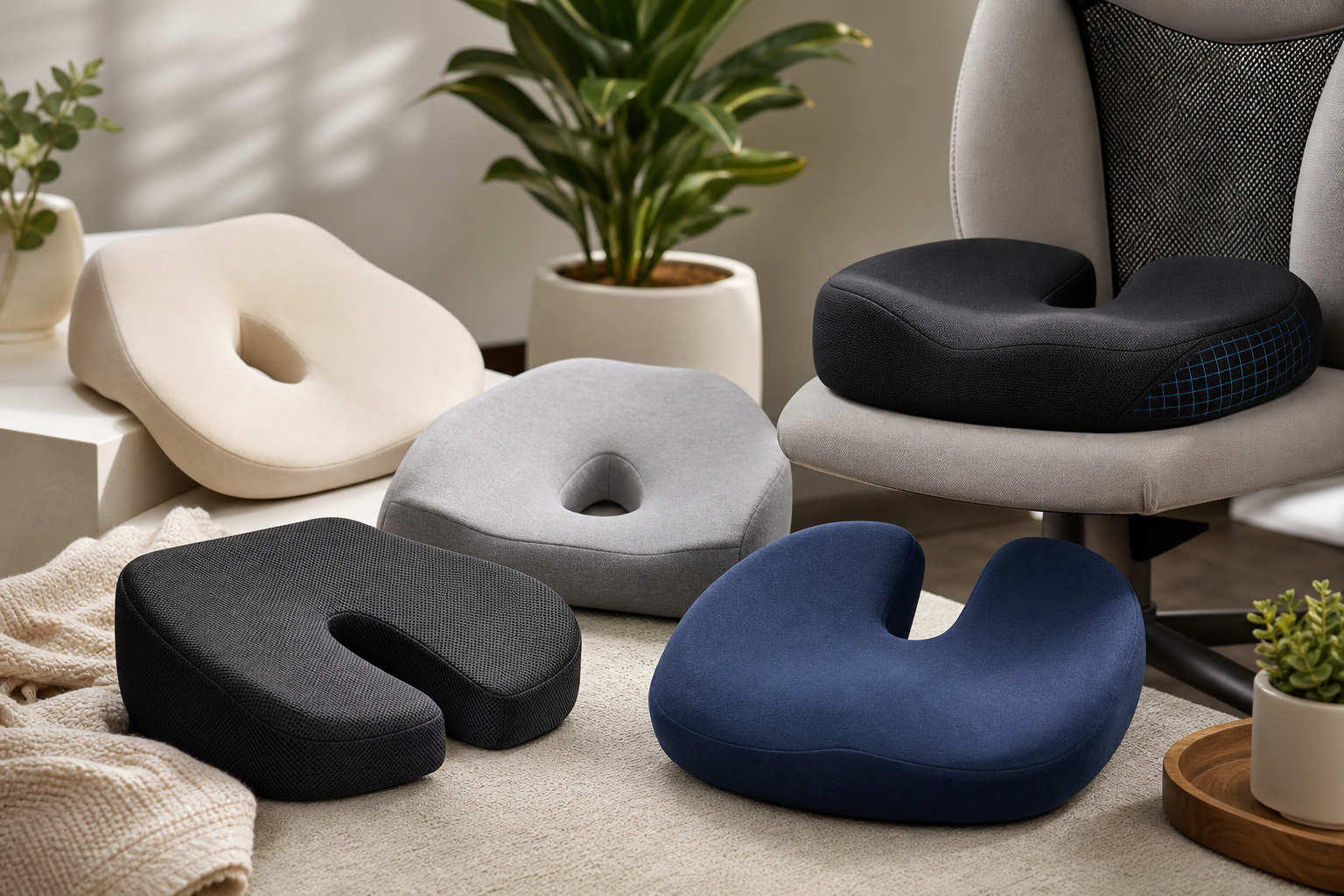
The coccyx cutout is the single most important feature
Across every source — from coccyx.org’s patient community to Popular Science’s hands-on testers — the consensus is that the U- or V-shaped cutout at the rear of the cushion is what actually relieves tailbone pressure. The mechanism is simple: the opening lets the coccyx float in free air rather than bear any body weight. Coccyx.org, a long-running patient-led resource, reports that the overwhelming majority of tailbone-pain sufferers find a cutout design more effective than ring-style or flat pads, a view echoed by workcomforthub.com’s ergonomics writers and comfyhuman.com’s 90-day test team. Health and Care’s UK-focused roundup arrives at the same conclusion from a different market.
High-density foam is not optional
Reviewers at comfyhuman.com and rosenberryrooms.com both found that cushions made from genuinely high-density memory foam maintained their shape across months of daily use, while budget models with lower-density fill compressed noticeably within weeks. Rosenberryrooms.com, which ran a 90-day evaluation with participants weighing 120 to 280 pounds, found that compression rates diverged sharply above 200 lbs — making foam density a critical purchasing variable for heavier individuals, not just a marketing number.
Non-slip bases and washable covers matter more than buyers expect
Popular Science notes that without a grippy anti-slip base, even well-performing cushions drift on smooth or mesh office chairs during ordinary fidgeting. Comfyhuman.com and workcomforthub.com both flag removable, machine-washable covers as a practical hygiene essential for year-round daily use — a consideration rarely prominent on product pages but consistently mentioned by long-term testers.
Cushions supplement movement breaks — they do not replace them
Coccyx.org cautions that no cushion eliminates the need for regular positional changes throughout the working day. Every review outlet treats these products as pain-management aids rather than cures, which is worth keeping in mind if you are hoping a seat pad will resolve chronic coccydynia on its own.
Where they disagree
Best overall: ComfiLife vs. Everlasting Comfort
The most prominent split among mainstream reviewers is over which product deserves the top ranking. Popular Science, after extended personal testing and input from chiropractors, names the ComfiLife Gel Enhanced as the best overall seat cushion for office use, crediting its cooling gel layer for managing heat without sacrificing contouring. Comfyhuman.com and rosenberryrooms.com both hand the crown to the Everlasting Comfort Memory Foam, citing its lifetime replacement guarantee and consistent performance across a wide range of user weights. Workcomforthub.com declines to choose between the two, arguing the decision mainly hinges on whether the buyer tends to overheat while sitting.
Memory foam vs. gel-infused vs. polymer grid
Material philosophy is where reviewers diverge most sharply. Comfyhuman.com argues that pure memory foam provides the most personalised body contouring because it softens and molds in response to body heat. Workcomforthub.com counters that gel-infused foam is the more practical everyday choice, since it does not stiffen in cold, air-conditioned offices — a recurring complaint in customer feedback on straight memory-foam products. At the premium end, both workcomforthub.com and Popular Science highlight the Purple Ultimate’s Hyper-Elastic Polymer grid as a product that never retains heat and never permanently compresses — but some users find the grid’s firm, unusual texture less comfortable than foam. There is no cross-source consensus winner across all three material types; the right choice depends on your thermal environment and tactile preference.
Donut rings vs. U-cutout cushions
Traditional medical practice has long recommended ring or donut cushions for pelvic and coccyx discomfort, and the AUVON donut pillow earns a legitimate place in rosenberryrooms.com’s rankings — specifically for postpartum and post-surgical use. However, coccyx.org’s patient community is emphatic that ring cushions were originally designed for genital-area pressure relief, not specifically for the coccyx, and that U-cutout designs prove more targeted and comfortable for tailbone pain as a standalone condition. Health and Care’s UK-focused guide similarly favours wedge-with-cutout designs over rings for long-term desk use, while acknowledging the ring’s niche medical role.
Optimal thickness: more padding is not always better
Rosenberryrooms.com’s 90-day testing found that the thickest cushion in its lineup did not rank highest for actual pain relief. The team argues that anything beyond about 3.5 inches tends to push the user too close to desk surfaces, requiring awkward chair-height adjustments that can introduce secondary discomfort. Comfyhuman.com takes a more nuanced position, saying thickness should scale with body weight: heavier users benefit from more material before compression sets in. Workcomforthub.com frames the tension bluntly, noting that portability and maximum thickness are fundamentally incompatible design goals.
Wedge angle and pelvic tilt
Workcomforthub.com draws a distinction between flat U-cutout pads — which primarily offload the tailbone — and genuine wedge designs such as the Aylio and the Tush-Cush, which also tilt the pelvis anteriorly to reduce lumbar disc pressure. Tush-Cush has manufactured its patented wedge-with-cutout design since 1987 and cites endorsement from pelvic health physiotherapist Allison McCreath, who recommends it for optimal sitting alignment.
Coccyx.org’s community notes, however, that an anteriorly tilted pelvis actually worsens pain for some patients, making individual trial essential before committing to a wedge-angled product.
Buying guide snapshot
- Most desk workers: A U-cutout memory-foam cushion around 3 inches thick covers the consensus — both the Everlasting Comfort and the ComfiLife Gel Enhanced represent the top tier at this level.
- If you run hot: Gel-infused foam (ComfiLife) or the Purple Ultimate’s polymer grid sidesteps the heat-retention complaints associated with plain memory foam in warm or poorly ventilated spaces.
- If you weigh over 200 lbs: Look explicitly for high-density foam or wider extended models; rosenberryrooms.com found compression rates diverge sharply above that threshold.
- If you are recovering from surgery or postpartum: The AUVON donut/ring form factor remains the medically endorsed choice for those specific circumstances, even if it is not the go-to for everyday tailbone pain.
- If a physiotherapist is managing your care: The Tush-Cush’s clinician-endorsed wedge design and multiple firmness options make it worth raising with your practitioner before purchasing.
FAQ
How is a coccyx cushion different from a regular seat cushion?
A standard seat cushion adds even padding across the entire sitting surface. A coccyx cushion has a deliberate U- or V-shaped opening at the rear so the tailbone makes no contact with any surface at all. As coccyx.org explains, this lets the coccyx float freely while the sitting bones (ischial tuberosities) bear the weight — a fundamentally different pressure distribution, not simply more padding.
Should I choose a donut pillow or a U-shaped cushion for isolated tailbone pain?
For day-to-day coccyx pain at a desk, the patient community at coccyx.org and the majority of independent review sites favour U-cutout designs over donut rings. Ring cushions were originally developed for perineal pressure relief and remain most appropriate for post-surgical or postpartum recovery. If you are unsure which category applies to your pain, rosenberryrooms.com covers both types in depth and notes that individual responses vary considerably.
Will a coccyx cushion work on any type of chair?
Most cushions are compatible with standard office chairs, car seats, and dining chairs, but a non-slip base is essential on smooth or mesh surfaces. Popular Science specifically found during office-chair testing that cushions without anti-slip materials shifted during normal movement. For vehicles, workcomforthub.com notes that thicker cushions can reduce headroom in lower-roofline cars — worth checking before buying a model above 4 inches.
How long does a coccyx cushion stay supportive before the foam flattens?
Rosenberryrooms.com’s 90-day test and comfyhuman.com’s extended evaluations both suggest quality high-density memory foam stays reliably supportive for one to two years under daily use. Lower-density budget options showed meaningful compression within weeks, especially for users over 200 lbs. The Everlasting Comfort’s lifetime replacement guarantee represents the most generous commitment documented across the roundups reviewed here.
Can a coccyx cushion also help with sciatica?
Several reviewers — including Popular Science and workcomforthub.com — note that U-cutout cushions are frequently used for both tailbone pain and sciatic nerve discomfort, reasoning that reducing lower-spine contact pressure can ease sciatic compression. However, coccyx.org cautions that sciatica and coccydynia have distinct anatomical causes, and that what relieves one does not automatically relieve the other. A physiotherapist assessment is advisable if you are managing both conditions at the same time.
Sources
- popsci.com
- comfyhuman.com
- workcomforthub.com
- coccyx.org
- rosenberryrooms.com
- healthandcare.co.uk
- tushcush.com
Related Articles