Best Wobble Stools in 2026: What Independent Reviewers Actually Think
Wobble stools promise to convert passive desk time into subtle, posture-building movement — but with dozens of models spanning $70 to over $500, choosing the wrong one is easy. We combed through seven independent review sources to surface what experienced testers actually agree and disagree on heading into 2026.
The short version
No single stool wins every category. Budget shoppers get the most consistent praise for the SONGMICS Ergonomic Wobble Stool; those who need a wide standing-desk height range are pointed toward the Uncaged Ergonomics Wobble Stool; and premium active-sitting enthusiasts still circle back to the Aeris Swopper despite its steep price. Across every source reviewed, one point is unanimous: plan to alternate wobble stool sessions with a conventional chair, particularly during the first few weeks of use.
What the reviews agree on
Wobble stools are not all-day chairs — at least not yet
Every source that addressed daily usage recommended treating wobble stools as part of a seating rotation rather than a full desk-chair replacement. DeskFitPro recommends 1–3 hours per day in rotating blocks, paired with standing and conventional chair periods. Chair Institute drew the same line for the Kore Office Plus, noting that all-day use is simply outside the product’s design intent. Even the premium Aeris Swopper — which Expert Reviews UK rated 4 out of 5 stars — is described across multiple sources as best suited to 1–2 hour sessions rather than full workdays.
The adaptation period is real and sometimes painful
Independent blogger Sebastian Gebski documented that his first 3–4 days on the Aeris Swopper caused “significant discomfort” before his core muscles adapted. DeskFitPro echoes this for high-tilt models, which “require core endurance buildup” from new users. Chair Institute found the Kore comfortable for short-to-medium sessions but flagged increasing fatigue beyond that. GoStanding.org, despite rating the Learniture Active Learning Stool 4.5 out of 5, still advises users to schedule regular breaks to manage back strain. The message is consistent across price points: build up gradually over one to four weeks.
Height range determines standing-desk compatibility
LeStallion’s seven-model roundup ranks height compatibility as a primary differentiator between stools. DeskFitPro and LeStallion both note that stools whose maximum height falls below 30 inches will not pair comfortably with most sit-stand desks set to a raised position. The Uncaged Ergonomics Wobble Stool’s 23–33 inch range earns repeated cross-source mentions for this reason, and DeskFitPro also highlights its 5-year warranty as a durability advantage. Notably, the Aeris Swopper tops out at 23.2 inches — making it better matched to a conventional fixed desk than to a raised standing-desk position.
Seat firmness is the most repeated criticism
Across budget and mid-range models, a hard or narrow seat is the single most recurring complaint. ErgonomicsHealth notes the Aeris Swopper’s 16-inch seat diameter as compact, with foam that reads as “firm for some people.” The Kore’s seat comfort ceiling is a consistent theme at Chair Institute. The SONGMICS models are a notable exception: their wider, padded seats earn comparatively warmer comfort notes from DeskFitPro’s testing.
Where they disagree
How much wobble is actually desirable?
This is the sharpest dividing line among published roundups. LeStallion’s top-ranked Desky Pro Active Sit Stand and its runner-up, the Backerz ActiveCore Pro, are praised for controlled, predictable movement — LeStallion describes the Backerz as “more controlled and grounded” than most rivals and frames this as a clear selling point. DeskFitPro, however, places a high-tilt 360-degree open-base model at the top of its list precisely because the more aggressive engagement stimulates core stabiliser muscles more effectively. The right answer depends on your goal: exercise stimulus favours more wobble; sustained focus during detail-heavy tasks favours less.
Is the Aeris Swopper worth its price?
No other product divides reviewers as sharply. Expert Reviews UK awarded it 4 out of 5 stars and called it “an excellent choice” for posture-conscious desk workers. ErgonomicsHealth similarly praises its 3D spring movement as the most advanced active seating mechanism tested. But Sebastian Gebski’s six-week hands-on account tells a more layered story: genuine posture and durability benefits, but also a high entry cost, limited adjustability beyond height, and the practical awkwardness of visibly bouncing during video calls. At approximately £470 in the UK — roughly five to seven times the price of a SONGMICS or Uncaged Ergonomics model — the disagreement is consequential for most buyers.
Can budget stools deliver comparable results?
DeskFitPro argues yes: the SONGMICS at roughly $70 is called a “solid mid-range option” with 4.3 stars drawn from more than 3,400 consumer reviews. LeStallion is less convinced, ranking the classroom-grade Learniture above budget alternatives on durability and seat design, even though their price points are close. If budget stools deliver the majority of ergonomic benefit at a fraction of the cost, the case for premium models narrows significantly for most desk workers — but no independent reviewer has yet published a long-term head-to-head comparison measuring outcomes over months of use.
Are safety rings a feature or a restriction?
The Kore Office Plus includes an anti-roll safety ring — a raised lip on the base that prevents extreme tilting. Chair Institute presents this as a stability benefit aimed at beginners and those new to active seating. By contrast, DeskFitPro and consumer review data suggest that more experienced users find the ring constrains range of motion compared to open-base designs such as the Uncaged Ergonomics Wobble Stool. Whether it is a safeguard or a handicap depends entirely on how comfortable you are with balance-training risk.
Quick comparison: wobble stools reviewed in 2026
| Stool | Approx. price | Height range | Key strength | Sourced from |
|---|---|---|---|---|
| Aeris Swopper | ~£470 / $500+ | 17.7″–23.2″ | Most advanced 3D spring movement; premium German build | Expert Reviews UK (4/5), ErgonomicsHealth, No-Kill-Switch blog |
| Uncaged Ergonomics Wobble Stool | ~$110 | 23″–33″ | Widest height range; 5-year warranty; open-base design | DeskFitPro |
| Desky Pro Active Sit Stand | — | — | Controlled wobble; saddle seat; 275 lb weight capacity | LeStallion (ranked #1, score 9.75/10) |
| SONGMICS Ergonomic Wobble Stool | ~$70 | 23.6″–33.3″ | Best value; padded wider seat; 275 lb capacity | DeskFitPro (best value pick) |
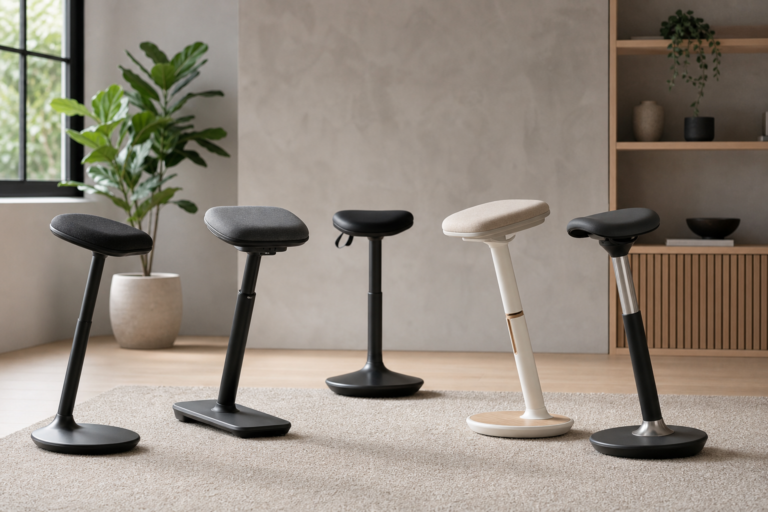
| Learniture Active Learning Stool | ~$90 | 18.5″–28″ | Classroom-tested durability; rocking base; 5-year warranty | GoStanding.org (4.5/5), ErgonomicsHealth, LeStallion |
| Kore Office Plus Wobble Stool | See retailer | 18.5″–32″ | Anti-roll safety ring; fabric and bonded-leather options | Chair Institute (3.9/5) |
| Backerz ActiveCore Pro | — | — | Controlled wobble; water-repellent upholstery; non-slip base ring | LeStallion (ranked #2, score 9.54/10) |
FAQ
How long should I use a wobble stool each day?
The cross-source consensus from DeskFitPro, Chair Institute, and ErgonomicsHealth is 1–3 hours per day in separate blocks, alternating with standing periods and a conventional chair. GoStanding.org suggests the Learniture can extend toward longer daily use once core muscles have adapted, but still recommends scheduled breaks throughout the day. No reviewed source recommends unbroken 8-hour days on a wobble stool.
Will a wobble stool help my back pain?
Reviewers are cautiously positive but deliberately measured. ErgonomicsHealth cites research associating active sitting with improved posture and core muscle strength, and owner reviews across multiple products report reduced back stiffness during work. DeskFitPro explicitly cautions, however, that wobble stools provide micro-movement benefits rather than significant pain elimination, and frames the effect as postural reinforcement rather than therapeutic treatment. If you have a diagnosed spinal condition, consult a physiotherapist before switching to active seating.
Do wobble stools work with standing desks?
Yes — pairing with a sit-stand desk is the primary intended use case for most models reviewed here. Match the stool’s maximum height to your raised desk height before buying. Most stools in this roundup target a 23–33 inch height range, suited to average-height users at standing-desk height. Shorter users may prefer the Learniture (18.5″–28″) or the Kore Classic configuration (18.5″–26.75″). Note that the Aeris Swopper, which tops out at 23.2 inches, is better suited to a conventional fixed desk than to a raised sit-stand desk.
Is the Aeris Swopper worth its price premium over budget stools?
Reviewers are split. Expert Reviews UK and ErgonomicsHealth say yes for users who are genuinely committed to active sitting as a long-term daily practice. Sebastian Gebski, after six weeks of daily use, found real value in posture enforcement and structural durability, but stopped short of calling it unambiguously worth five to seven times the price of a mid-range alternative. If you can trial one before purchasing, do so — this is a product where individual fit and personal commitment to active sitting matter more than averaged review scores suggest.
What weight capacities should I look for?
Most mid-range wobble stools support 250–275 lbs (approximately 113–125 kg). The Kore Office Plus and Uncaged Ergonomics Wobble Stool are each rated to 250 lbs; both SONGMICS models reviewed by DeskFitPro support 275 lbs. Chair Institute flags the Kore’s 250 lb limit as worth double-checking before purchase. The Aeris Swopper specifies weight limits by spring stiffness setting rather than a single universal figure — confirm the correct spring configuration for your weight directly with the manufacturer or retailer.
Sources
- deskfitpro.com
- lestallion.com
- ergonomicshealth.com
- expertreviews.co.uk
- no-kill-switch.ghost.io
- chairinstitute.com
- gostanding.org
- ergonomicshealth.com
Related Articles